Journeying Through China in Faith, Memory, and Friendship: Reflections on a 2026 Cultural Tour of China Hosted by Peter Tan
Updated: Aug 20
By Fr. Joseph Ruan

During April 17–27, 2026, fourteen Catholics from the United States embarked on an unforgettable ten-day spiritual and cultural journey across mainland China. Organized by Mr. Peter Tan, with the assistance of Apollo Travel & Tours and local guides, the trip brought together a uniquely diverse group of travelers: local American Catholics, Chinese American Catholics from different backgrounds, and three Mexican American Catholics. Some pilgrims traveled from Texas, Chicago, New Jersey and other states; others transited through Taiwan before arriving in Beijing. Fr. Joseph Ruan joined the group from Fuzhou.
Although the pilgrims came from different ethnic backgrounds, cultures, languages, and life experiences, everyone shared one common faith. In many ways, the pilgrimage itself became a living image of the Catholic Church — universal, diverse, and united in Christ.
From the very beginning, there was a spirit of joy and anticipation. At the airport and throughout the journey, English, Mandarin, Cantonese, and Spanish naturally blended together in conversation. Some travelers translated for others; some helped older pilgrims carry luggage; others shared stories of immigration, family, parish life, and faith experiences in America.
Very quickly, the group no longer felt like tourists traveling together. Instead, the pilgrims began to feel like one family.
Beijing — Encountering Ancient Civilization and Modern China
Our trip officially began in Beijing, one of the world’s great historical capitals. For many of the American pilgrims, China immediately shattered old stereotypes and assumptions. The modern airport infrastructure, efficient transportation systems, high-speed trains, clean streets, and thriving city life surprised many who still carried outdated images of China in their minds.
Several pilgrims openly admitted that they had not expected China to appear so modern, developed, organized, and technologically advanced.
Yet Beijing also revealed another dimension of China — the depth of its civilization and historical memory.

For Christians, however, these places also inspired spiritual reflection. Dynasties rise and fall. Political powers come and go. Yet the Kingdom of God alone remains eternal.
The pilgrims also visited the Summer Palace and explored traditional Beijing hutongs, where traces of old Chinese life still survive amid rapid modernization.


One particularly memorable experience was climbing the Mutianyu section of the Great Wall. Some pilgrims climbed energetically while others moved more slowly and carefully, encouraging one another along the way.
Standing atop the ancient stones overlooking the mountains, many reflected on the perseverance required both in history and in faith.
Faith itself often resembles climbing a great wall — sometimes difficult, sometimes exhausting, yet always opening toward a wider horizon.
Sunday Mass at Beijing Dongtang

One of the most spiritually moving moments of the tour came during Sunday Mass at St. Joseph’s Church in Beijing, commonly known as Dongtang (East Church).
Founded in 1655 by the Jesuits, Dongtang is one of the oldest Catholic churches in Beijing. Over the centuries, it has survived wars, fires, revolutions, and political upheaval. Today, it stands not merely as a historical building, but as a living witness to the perseverance of Catholic faith in China.
As the pilgrims entered the church on Sunday morning, many immediately sensed something special. The church was already filled with worshippers quietly before Mass. Young adults and families entered reverently. The atmosphere was deeply prayerful and dignified.

For many of the American and Mexican-American pilgrims, this was their very first experience attending Mass inside a Catholic church in mainland China. They were deeply moved by the devotion of the local faithful, the beauty of the liturgy, and the reverence shown throughout the Mass.
For Fr. Joseph Ruan, the experience carried even deeper emotional significance because he was invited to concelebrate the Mass. Standing once again at the altar of a Chinese church after decades of priestly ministry in New York stirred many memories and emotions.
At that moment, everyone felt strongly that the Eucharist truly transcends all boundaries of language, nationality, politics, and history. Whether in New York, Mexico, Beijing, or Rome, Catholics gather around the same altar and receive the same Body of Christ.
Xi’an — Ancient Civilization and Ancient Faith
From Beijing, the group traveled to Xi’an aboard China’s remarkable high-speed rail system. Many pilgrims were amazed by the speed, comfort, and efficiency of the trains.

Watching the Chinese countryside pass rapidly outside the windows while sharing stories and laughter together became one of the warmest parts of the trip.
Xi’an, one of the oldest cities in China and the ancient eastern gateway of the Silk Road, revealed another dimension of Chinese history.

The Terracotta Warriors left the group speechless. Thousands of life-sized soldiers buried underground for more than two thousand years testified to the sophistication, ambition, and historical depth of ancient Chinese civilization.
Yet Xi’an also carries deep significance for Christianity in China. The Silk Road once carried not only commerce but also religion, including early Christianity, across Asia.
In Xi’an, the pilgrims visited the historic South Cathedral (Nantang), dedicated to St. Francis.
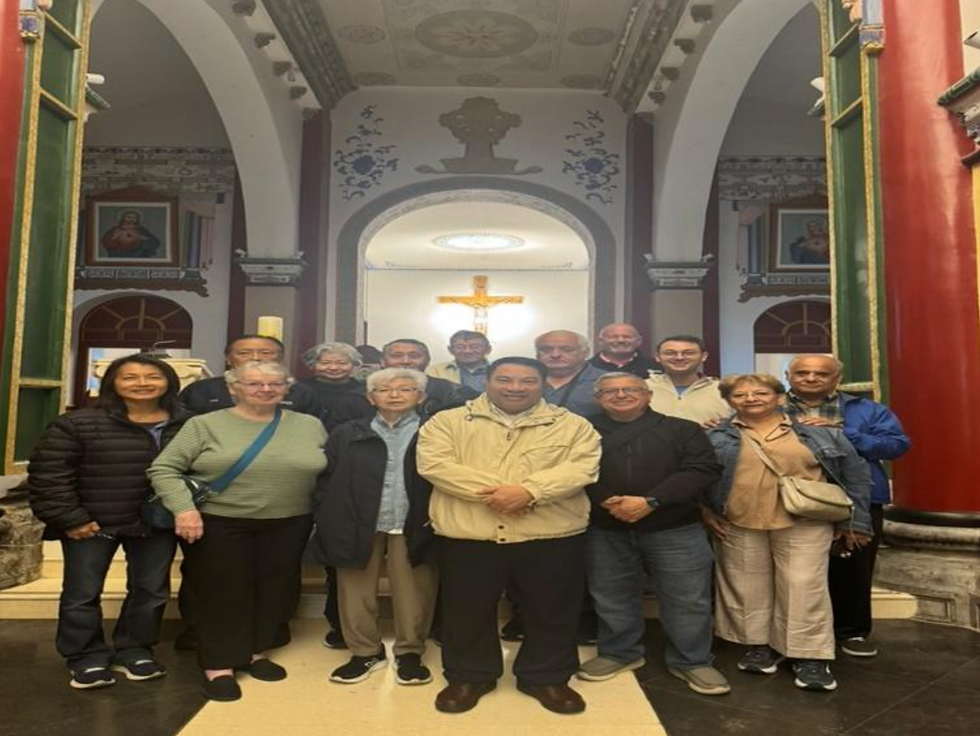
Founded in the early eighteenth century, the cathedral remains one of the oldest Catholic churches in northwestern China. Although modest compared to Europe’s great cathedrals, the church radiates quiet dignity and historical depth.
Inside the cathedral, the pilgrims prayed together and softly sang hymns. There was a profound sense that generations of Chinese Catholics had prayed within those same walls through periods of peace, hardship, and suffering alike.
Many pilgrims later shared that praying inside these ancient churches touched them even more deeply than visiting famous tourist sites.
In those sacred places, history suddenly became alive and personal.
Hangzhou — Beauty, Prayer, and Chinese Culture
From Xi’an, the group flew southward to Hangzhou, one of China’s most beautiful and culturally celebrated cities.
The ancient Chinese saying declares, “Above there is heaven; below there are Suzhou and Hangzhou.” As the pilgrims glided across West Lake beneath misty skies and willow trees, everyone understood why poets and artists had praised this region for centuries.
The beauty of Hangzhou felt almost poetic.

Hangzhou also offered another important spiritual stop: the local Catholic cathedral.

Though smaller and less internationally known than churches in Beijing or Shanghai, the cathedral reflected the quiet elegance and gentleness often associated with southern Chinese culture.
The pilgrims paused there for prayer and song, once again reminded that the Church in China lives not only in famous cities but also in countless local communities throughout the country.
The group also visited tea plantations, ancient streets, and cultural sites that revealed the depth of Chinese artistic and philosophical traditions.

Tongli and Suzhou — Harmony and Friendship
The tour then continued into the Jiangnan region — Tongli and Suzhou — where classical Chinese culture seemed to unfold like a living painting.
The canals, stone bridges, whitewashed walls, narrow waterways, and quiet gardens fascinated many of the American pilgrims.

For some, it was their first experience of the poetic beauty so often depicted in traditional Chinese art and literature.

In Suzhou, the group visited classical gardens, silk factories, and the famous Hanshan Temple. The harmony between architecture, water, trees, and stone reflected a uniquely Chinese understanding of beauty and balance.
Many pilgrims began reflecting on how Chinese civilization values harmony, patience, family, respect for tradition, and interior peace. These values resonated deeply with Christian spirituality in unexpected ways.
One particularly joyful moment occurred in a traditional cultural hall, where one pilgrim jokingly posed like an ancient Chinese scholar at a writing desk, causing the entire group to burst into laughter.
Moments like these reminded everyone that pilgrimage is not only about prayer and reflection, but also about joy, friendship, and shared humanity.
Shared Meals, Friendship, and Cultural Discovery
One of the great joys of the trip was simply sharing meals together.

Whether enjoying Beijing duck, Xi’an dumpling banquets, Hangzhou cuisine, Suzhou specialties, or Shanghai dishes, every meal became an opportunity for conversation, laughter, and friendship.
The three Mexican-American pilgrims especially delighted in discovering authentic Chinese food and culture. One of them joked that he never imagined eating dumplings in Xi’an while discussing Catholic theology with Chinese-Americans and local Americans together.
Yet that was precisely the beauty of the trip.
Different peoples, different histories, different cultures — united through faith.
The group also spent joyful moments shopping for souvenirs, tea, silk, panda gifts, religious items, and local crafts.
Many pilgrims became like excited children in the marketplaces, eager to bring home gifts and memories for friends and family.
Throughout the trip, friendships deepened naturally. Pilgrims helped one another, shared snacks and stories, looked after older members, and supported each other throughout the long days of travel.
Many later remarked that the warmth and unity of the group became one of the greatest blessings of the trip.
Sheshan — Returning to the Roots of a Vocation
The spiritual climax of the tour came when the group arrived at the Basilica of Our Lady of Sheshan near Shanghai.

Sheshan is the most important Marian shrine in China and holds immense significance for Chinese Catholics. Perched upon a peaceful hill surrounded by trees, the basilica has become a symbol of hope, perseverance, and devotion for generations of believers.
For Fr. Joseph Ruan, however, Sheshan carries even deeper meaning.
From 1983 to 1989, he studied at Sheshan Seminary during a crucial period in the rebuilding of the Church in China after years of hardship.
Those seminary years shaped his priestly vocation and his entire life.
On June 24, 1989 — the Feast of the Nativity of St. John the Baptist — Fr. Ruan was ordained to the priesthood at the Basilica of Our Lady of Sheshan.
His first Mass as a newly ordained priest was celebrated shortly afterward at St. Ignatius Cathedral in Xujiahui, Shanghai.
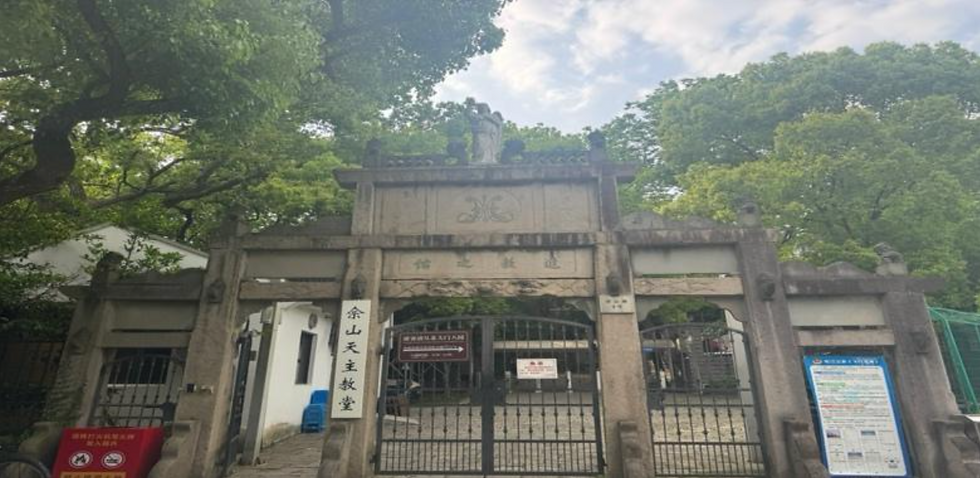
Returning to Sheshan more than thirty years later became an intensely emotional experience.
As Fr. Ruan walked once again through the seminary grounds and climbed the familiar paths toward the basilica, memories flooded back with extraordinary clarity.
The trees, the pathways, the shrine, the statue of Our Lady — so much remained familiar. Yet time had passed.
Many former classmates and professors were now scattered throughout the world; some had already entered eternal life.
Standing once again before the altar where his priesthood began, Fr. Ruan could only feel deep gratitude.
When the group gathered before Our Lady of Sheshan to sing Marian hymns and pray together for China, for the Church, and for peace, many pilgrims were visibly moved.
Some later shared that this was the most powerful spiritual moment of the entire trip.
At Sheshan, the group was no longer simply visiting a religious site.
They had become true pilgrims.
Xujiahui Cathedral — Returning After Thirty Years
That evening, the group traveled into Shanghai and attended Mass at St. Ignatius Cathedral in Xujiahui.

The magnificent red-brick Gothic cathedral, illuminated beneath the evening sky, stood as once known as the “cathedral of the Far East”.

For Fr. Joseph Ruan, concelebrating Mass there once again after more than three decades carried profound emotional weight.
As a young newly ordained priest, he had once stood at that same altar full of youthful dreams and zeal.
Returning now after decades of ministry in New York, he carried not youthful idealism alone, but also the deeper gratitude that comes through years of pastoral service, sacrifice, struggle, and grace.
Many pilgrims later said that hearing these personal memories transformed the churches from mere historical monuments into living testimonies of vocation, faith, and perseverance.
Standing before the cathedral after Mass, many members of the group lingered for photographs beneath the illuminated towers and glowing cross.
The church represented not only architectural beauty, but also the enduring history of Catholicism in China.
Conclusion — More Than a Journey
Throughout the trip, the local guides and organizers contributed greatly to the experience.

The group remains deeply grateful to Peter Tan, Apollo Travel & Tours, and all the local guides whose careful planning, hospitality, historical explanations, transportation coordination, and warm companionship made the journey so successful and enjoyable.
As the trip finally came to an end in Shanghai, many participants found it difficult to say goodbye.
At the airport, people continued exchanging photographs, sharing memories, and already speaking about future trips together.
In just eleven days, the group had shared prayer, friendship, laughter, meals, stories, and sacred moments across thousands of miles.
The pilgrims returned home carrying much more than souvenirs and photographs.
They carried home a deeper understanding of China, a renewed appreciation for Chinese Catholicism, a stronger awareness of the universality of the Church, and a profound gratitude for the way faith can unite people of every ethnicity and culture.
For many overseas Chinese Catholics, journeys such as this are more than tourism.
They become moments of rediscovery — rediscovery of cultural roots, rediscovery of the history of the Church in China, and rediscovery of the universal nature of Catholic faith.
Perhaps this is one of the important missions of organizations like USCCA: to build bridges between cultures, generations, and communities of faith, so that Chinese Catholics around the world may continue walking together in communion, hope, and service to the Gospel.
In the end, this tour was not simply about visiting China.
It was about encountering history, culture, memory, faith, friendship, and above all, the enduring presence of God along the road.
Fr. (Joseph) Guozhang Ruan was born and ordained in China. After serving in parish ministry in the Diocese of Mindong, Fujian, he pursued advanced studies in moral theology in Rome, earning a doctorate from the Pontifical Lateran University. Since coming to the United States in 2004, he has served in several parishes in the Archdiocese of New York. He is currently the Director of the Chinese Apostolate for the Archdiocese of New York and Parochial Vicar of Holy Rosary Church on Staten Island. His ministry focuses on serving Chinese Catholics, promoting evangelization, and fostering greater understanding between the Church in China and the universal Church.
----------------------
The USCCA is a 501(c)3 tax-exempt organization. Your donations are tax-deductible to the maximum extent allowed by law. The success of our work depends upon the generosity of people like you.